Welcome!


Welcome! I am Samuel Young, a member of The Church of Jesus Christ of Latter-day Saints. This website, previously a blog about my experiences as a missionary, is about my post-mission life. If you have questions about anything, feel free to ask me! You can send me a Facebook message or leave a comment. The things that I write or post here are my own views and are not authorized or official statements of the Church. Make it a wonderful day!

Sunday, September 2, 2018

Thoughts on Using the Full Name of the Church

I’ll admit that I was a little surprised by President Nelson’s public and forceful admonition to supplant the term “Mormon” with the full name of the Church, “The Church of Jesus Christ of Latter-day Saints”. His statement appears on the Church’s Newsroom site as follows:

The Lord has impressed upon my mind the importance of the name He has revealed for His Church, even The Church of Jesus Christ of Latter-day Saints. We have work before us to bring ourselves in harmony with His will. In recent weeks, various Church leaders and departments have initiated the necessary steps to do so. Additional information about this important matter will be made available in the coming months.

The responses to his statement have been quite predictable, ranging from a Jordan Petersonesque rejection of free speech restrictions and absolutist “You’re rejecting the prophet if you don’t comply” views to positivist (“President Hinckley tried this years ago and it was a marketing disaster”), non-compliance critical (“Why is Mormon Newsroom called just ‘Newsroom’ now but still located at www.mormonnewsroom.com?”) and invariantist (“Why would the Church first promote its affiliation with the term ‘Mormon’ with the I’m a Mormon campaign, but now retract that connection?”). In my survey, discourse surrounding the name adjustment seem to involve a few key themes:

  • The age-old supremacy conflict between institutional authority and individual conscience
  • The legitimacy of a seemingly pedantic stylistic naming standard
  • The function of a group name in constructing group identity and mediating individual responsibility

My personal view is that the push to use the full name of the Church, “The Church of Jesus Christ of Latter-day Saints”, carries monumental positive potential. Using the Church’s correct name promotes accuracy in discourse about the Church in the context of other Mormon churches, pressures members to affiliate out of integrity instead of compliance, and helps immunize the collective membership against group identity attacks.

1. Fostering Precision to Facilitate Accurate Discourse about the Church

An obvious reason for pressuring use of the Church’s full name in colloquial and formal use is to distinguish the Church from other similarly named organizations, many of which diverged from the Church in previous history and teach doctrines that negate or conflict with official Church doctrine. There exist at least 20 religions that diverge from the church originally organized by Joseph Smith, Jr. on 06 April 1830 and many of them diverged from the mainline Church precisely because of doctrinal conflict. Potential for misattribution of offshoot groups’ doctrine to the Church has always challenged the Church’s growth, especially when offshoot groups’ practices affront generally accepted social mores.

Graphs tracing the history of these offshoot groups are complex, and many groups contain “Latter”, “Saints”, and “Church of Jesus Christ” in their names. Confusion of these groups with the Church seems still imminent even if all Church members were to use the Church’s full name in colloquial usage, but the specificity of using the full name in disambiguating the groups is certainly better than using the term “LDS”, and undoubtedly better than using the more global terms “Mormon” or “Mormonism”, which in cultural research circles often signal the entire Latter-Day Saint movement.

In addition to emphasizing the Church’s focus on Jesus Christ (the lack of which some disaffected members criticize[1]), using the full name is a sign of respect and compassion to people not versed in the pedigree of Mormon churches that have peppered the religious history of the United States.

This stance is not surprising, given that President Nelson’s career as one of the world’s leading cardiac surgeons depended critically on the use of precise language. Many of the conflations of The Church of Jesus Christ of Latter-day Saints with other Mormon churches are often completely avoidable. Though many active Church members would likely recognize a demand on investigators and non-members to cogently discern the Church’s place in the Mormon church pedigree (perhaps even suggesting that mistaken conflation of the Church with offshoot groups indicates spiritual immaturity—for example, “He must not be ready for missionaries if he is convinced the Church still practices polygamy”) as clearly entitlist, this is the message we help co-construct by playing fast and loose with the term “Mormon”.

By using the full name of the Church and, by extension, adopting a more precise nomenclature that may seem pedantic, we are actively creating a culture of specificity that better serves members and non-members of the Church. Increased accuracy in discerning our affiliation to a specific church allows those investigating or questioning to make more informed decisions about whether to be baptized or stay active. It also fosters and encourages transparency regarding the Church’s history, as unpopular or disturbing facts can no longer be attributed to only divergent offshoot groups—this pressures us to directly and truthfully confront our collective past and present immaturities, which in turn pressures opponents of the Church to confront their own[2] and increases the potential for people to trust the Church’s organization and members.

2. Promoting Integritous Affiliation

Related to the accuracy that a more pedantic but more precise nomenclature offers are the important psychological effects on the way Church members construct their identity in relation to their affiliation with the Church. The push to use the fully-qualified name of the Church, “The Church of Jesus Christ of Latter-day Saints”, represents a long-needed and unquestionably beneficial shift towards deconstructing the inappropriate conflation of the Church’s unique doctrinal framework and teachings with a number of annoying and sometimes downright toxic cultural practices of some of the Church’s members.

Many members construct their affiliation with Church largely in terms of cultural performance[3]. For some members, compliance to cultural norms holds as much or greater weight than deliberate, informed application of principles of the Gospel of Jesus Christ in relevant areas of their lives. For example, some members believe that marriage after one has reached a certain age necessarily indicates spiritual immaturity, unworthiness, or rebellious repudiation of prophetic counsel. Others hold that one’s spirit is in dire danger unless one reads the Ensign every month, or remains on one’s knees for a full minute after ending a prayer in order to hear God’s answers. While well-intentioned and with possible support from scriptures and statements from General Authorities, constructing a sense of “Mormon” identity based on mere compliance to cultural norms or even to legitimate commandments can be very problematic.

Living in a compliance-based identity can deeply undermine one’s development and progression towards exaltation. We take comfort in absolutist thinking and in the idea of Church leaders and members who provide inerrant counsel at every turn of life’s vicissitudes, and in the easy external validation that results from our compliance, even when that compliance won’t truly pressure us to develop our God-given capacities and traits. While it’s false to say that compliance has no value, especially when first learning a gospel concept, remaining in that frame encourages an unhealthy dependency on other people. We co-construct our misery by believing that we need others’ validation in order to feel truly good or virtuous, creating vulnerabilities by which others can manipulate us against what is truly good for us.

Advocating for a technically correct appellation of the Church and redefining members long ensconced in Mormon-branded coteries as mere individuals forced to choose affiliation or non-affiliation for themselves pressures members to avoid the ungodly compliance-complacence pattern of culturally validated membership. Exposing the reek of this lifestyle is a legitimate critique in many inimical anti-Mormon commentaries. Instead of fluently passing off cultural compliance for loyalty to a lifestyle and mission defined by Christ’s teachings, we must now construct individual identities, with full possibility of others’ invalidation, and choose whether to include Christ’s gospel in them.

Calling ourselves “members of the Church” rather than “Mormons” also emphasizes the idea that affiliation is a choice that is continually made, not a one-time declaration of a culturally validated identity that will never be challenged against one’s integrity (which closely mirrors the evangelical sola fide doctrine that the Restoration repudiates). Constructing one’s identity as a Church member is much more aligned with the scriptural pattern of continual self-appraisal demonstrated in Alma’s remonstrances towards the Zarahemlites in Alma 5. In an integrity-based frame of living, one must take more ownership for the choice to affiliate or disaffiliate, even when it is hard. Self-definition can be frightening, not just due to risk of invalidation, but also because it necessarily involves defining who and what you will not be. Coming to peace with yourself about what you want to create with your life, and accepting that your limited resources and strength preclude always shining in the eyes of your group, is a large part of God-like process of exaltation.

Similarity to Other Recent Church-wide Changes

It’s worth noting that the theme and presentation of the Church’s name adjustment is consistent with other Church-wide changes announced thus far into President Nelson’s tenure, including the consolidation of home and visiting teaching into a singular ministering concept, as well as the near-total jettisoning of high priests groups. To me, these three changes center around pressuring Church members to shift from a compliance-based frame of living to an integrity-based frame.

Though one published reason for the near-disbanding of high priests groups was to make available to younger elders the experience and wisdom isolated in high priests groups (in some situations, elders ordained to be high priests never return to or rarely affiliate with their previous colleagues), I believe that there may have been another potent reason for this adjustment. I believe that, in some (but not all) Church units, high priests group meetings may have become a type of “old men’s club”: a place where, for an hour, members could tie their age to a sense of superiority, averting personal growth, and imagining the inerrancy of their perspectives by virtue of age (eg., Laman and Lemuel’s logical fallacies in 2 Nephi 5:3). I think it basically became a place where one might have almost said, “I’ve made it. I’ve been faithful in the Church, and my great-grandchildren have all been married in the temple, and now I can sit back and relish in my successes with my chums and discuss deep doctrine for an hour.”

This, of course, isn’t universal, and there is, of course, nothing inherently evil about rejoicing in the good fruits of one’s righteous and legitimate efforts. But it’s clear to me that growing into a sense of entitlement by falsely conflating the near-finality of one’s mortal life with one’s ongoing and largely incomplete spiritual development helps neither that person nor other less-experienced members nearby. Individual spiritual progress will be ongoing for millennia, and one needs to accept and acknowledge the reality of one’s continually underdeveloped state without interpreting that reality as a tarnish on one’s own identity, or seeking for other peers to reassure one’s sense of self (à la Laman and Lemuel, perhaps). Bringing high priests back into the game, so to speak, seems like a wonderful way to facilitate this. As with the Church’s name adjustment, this change carries a linguistic shift from “high” priests to “elders”, which could be interpreted as an emphasis on one’s continued post of responsibility rather than on one’s attained social status.

The collapsing of home and visiting teaching into a unified ministering program is possibly a more obvious statement of the need for integrity-based living. It’s telling that Elder Holland’s last General Conference message on ministering before the official change rejected both a checklist-based attitude of being in relation with others of God’s children and a transactional, compliance-based way of measuring adherence to Heavenly Father’s command to “watch over the Church always” (see D&C 20:53).[4] These themes had likely been considered at least since 2016 (the year of that talk), and were expanded and propounded further in the April 2018 general conference. Home and visiting teaching efforts were remodeled to incorporate a much more feminine approach of being in relationship with others—ministers are enjoined to be so trustworthy to and invested in their ministerees that ministerees can trust them with intimate details of life and instinctually turn to them in times of crisis.

The new ministering efforts target individuals’ holistic well-being, more closely resembling the Compassionate Service efforts within the Church’s Relief Society than “priesthood service”. The new ministering program, really a restatement of what I believe was always the higher ultimate goal of the old home and visiting teaching programs, is to be grow into a pattern of intentional, relational involvement with others. As with other Church programs, it directly combats the technological atomization of individuals in today’s post-modern societies and enjoins the greater levels of intimacy and connectedness that I believe are critical for high-level functionality in post-mortal celestial societies. Again, an important linguistic shift accompanied this change: the shift from “teaching” efforts to “ministering” indicate a shift from overt, complying behaviors to deeper, less transactional relationships.

The pattern with the Church’s name adjustment is the same: a shift from validation-based living to the more godlike (and ultimately more satisfying) frame of integrity-based living, in which one derives self-actualization from actively and continually constructing one’s own exaltant development by building the kingdom of God on the earth, rather than by vulnerably relying on flawed, fickle humans to provide that satisfaction.

3. Mediation of Group Identity Attack Vulnerability

An third important byproduct of the name adjustment is that fostering integritous gospel living in the Saints provides some insulation against group identity attacks. Often, individual members of the Church are envisioned to carry the (perceived) traits of one or more Mormon collectives. This is an example of a divisive distribution fallacy. Or, inversely, the Church as an entire institution is envisioned to carry the undesirable traits of an individual member or members (similar to a compositive distribution fallacy).

By instead constructing members as independent automatons who continually choose affiliation rather than involuntarily assuming an expansive Mormon identity, the Church is directly defusing group identity attacks that depend on these fallacies. (It’s worth noting that the atomization encouraged by the name adjustment is an atomization of agency and accountability—really a restatement of the second Article of Faith—not the intimacy-avoidant atomization of relationships mentioned before.)

Many ideological conflicts between proponents and opponents of Church organization, doctrine, and leadership can be expressed as a co-construction of both parties. For example, pro-Mormons identify as a group, collecting dissidents into a single “anti-Mormon” group and using anti-Mormons’ repudiation of doctrine or leadership to justify not addressing real cultural and social immaturities present among the collective of active members. Similarly, the collective of Church opponents point to active members’ refusal to address or even acknowledge prophetic fallibility or cultural injustices as justification for disaffiliation or offense against Church members.

Group identity tactics often instill anxiety and fear about members of the outgroups. They also obscure the true issues causing conflict by conflating the outgroup with the conflict, and thrive in a compliance- and validation-based environment. What is difficult is that addressing one’s own immaturities and flaws is often the only way to break the deadlock, and the Church comes into understandable internal conflict about doing this because it seems to compromise the message it bears to the world. The way out of this conflict, in my opinion, is to deepen one’s understanding of truth to include both the divinity of the message of the restored gospel and the fallibility of the individuals presenting it. As Jennifer Finlayson-Fife notes, this requires a shift from compliance-based living to integrity-based living.

Given the rich historical hindsight of the Book of Mormon, whose people frequently applied similarly flattening labels (eg., Jacob’s functional definitions of Lamanites vs. Nephites in Jacob 1:14) despite notable exceptions within each group (eg., the children in the time of King Benjamin, Abish, etc.), it’s very telling of our immaturity that we continue to repeat their tactics. Again, many Church members take comfort in simplistic, absolutist framing of compliance and non-compliance to published standards and policies as necessarily indicative of total good or evil. This masks the intricacies and variegated life histories that influence overt behavior in an individual, and many disaffected with the Church lament (legitimately, in my opinion) the feeling of being intentionally misunderstood.

Thus, using the full name of the Church in referring to members is one way the Church is taking the very mature step of addressing the group identity politics that it has helped foster among its members. (Member Jeremy “Gogo” Goff interprets the name adjustment as God calling on His own Church to repent.) By encouraging members to see themselves as individuals who individually choose affiliation and a gospel lifestyle, the change confronts outsiders’ and opponents’ distribution fallacies with the reality that active Church members vary widely in individual agentic religious practice, and “deficiencies” in performance cannot be attributed entirely to a religious institution (or to the devil). It also pressures members and other individuals to partition the Church’s doctrine from the cultural or traditional practices of its members and to be more accurate about what exactly seems or feels offensive (although, in my opinion, the Church could better facilitate this pattern of higher-level thinking by explicitly declaring the conflation of Church doctrine and the culture of Church members as two separate concepts, not simply renaming it “the gospel of Jesus Christ”).

In my opinion, such a way of living is more in keeping with the scriptural ideal of individual accountability for actions (see Mosiah 29:38 and Article of Faith 2). Deficiencies in leaders can now be better contextualized within the reality of telestial life, which includes that person’s individual underdevelopedness. I believe that this is the view God takes of fallible mortals, and this view makes it easier to tolerate the childishness, indifference, and even cruelty of associates in the Church without illogically jettisoning the entire Church and the blessings it offers us even while we are in pain.

Conclusion

The adjustment to prioritize more consistent and persistent use of “The Church of Jesus Christ of Latter-day Saints” as the name of the Church, as well as the corresponding admonition to construct one’s membership as an integritously deliberated choice represent a much-needed cultural shift among members of the Church. The change promotes precision in language that is compassionate to those unfamiliar with our Church’s history and establishes basic defenses against common distribution fallacy attacks.

Hearing about this change and contemplating the swath of cultural issues connected to the Church’s name has reinforced my testimony of the prophetic calling of Russell M. Nelson. I believe that the cultural adjustments in progress under his administration can better extend the compassion and Atonement of Jesus Christ to people who have desperately thirsted for it amidst the reality of cultural false traditions that stymie their sincere search. I have great hope that similar changes will come with President Nelson as the Prophet, and express my faith that Jesus Christ is a personal Savior to each of us and the propagator of all that is good about godlike living.

I see these changes as an expression of our Heavenly Parents’ love and concern for us. They have not forgotten us, and are doing all that they can to advance our happiness and progress towards true, full self-actualization—essential components of a rich, eternal life.


  1. Anecdotally, one of the big pushes behind the emphasis on Sabbath Day quality arose in part from a sacrament meeting sometime in 2014 or 2015 to which Elder Holland took an investigator friend. The story goes that members seemed inattentive, the bishop was collecting tithing before the meeting, and it felt clear that people weren't attending with intention. A separate story holds that during a fast and testimony meeting, people bore testimony of ancillary facets and programs of the Church, but didn't mention Jesus Christ even once. ↩︎

  2. The co-construction of relational conflict and the concept of indirectly pressuring development in a relationship partner by pressuring one's own development are common themes in the canonical gospels and in the work of Jennifer Finlayson-Fife. ↩︎

  3. Brad Wilcox in Filling Your Testimony Tank: "If there's one thing that [Mormons] do, we do church." (Approximate quotation.) ↩︎

  4. It’s worth noting that over approximately the same time frame, several key indicators have been dropped from the reporting requirements for full-time missionaries. Currently, missionaries report on just five periodic key indicators:

    • Number of people baptized
    • Number of people confirmed
    • Number of people with a date to be baptized
    • Number of people who attended sacrament meeting
    • Number of new people being taught
    ↩︎

Thursday, February 25, 2016

Becoming As a Little Child

In the last few months, I've become a Sunbeam teacher in my church. What that means is that I'm in charge of teaching and watching over the three-year-olds for two hours so that their parents can attend Sunday School and other Church meetings. It has been an amazing experience, a roller-coaster ride at times, and has made me really think about what little children mean.

When I was on my mission, I was on exchanges once with our zone leaders. The zone leaders covered a young single adult ward, and they had a dinner appointment that night with a family I didn't know. When we got there, the whole time there was this very friendly six-year-old girl named Katie who would come up to us and ask us questions and tell us how her day at school was and show us her stuffed animal and so on. At first it was a little annoying (you could see her dad with a tired look on his face sighing as he hopelessly tried to stop her from "harassing" us), but slowly the persistent, impetuous annoyance turned into something different.

At another time, Elder Camerone* and I were visiting a new family who had just moved into our ward. While we were sharing a spiritual thought and asking if they knew anyone we could teach, their little three-year-old walked in, laden with toy cooking utensils and necklaces that she wanted us missionaries to hold so she could play some sort of game. At one point, Elder Camerone jokingly said, "She wants to play make believe? Her entire world is make believe!"

At yet another time, I was in the car with a family that had a little three-year-old boy that was known for being rowdy and hard to manage. I'm pretty convinced his mother is an angel for dealing with him, his younger sister, and being pregnant with another one on the way. It was near Halloween, and Dad points out, "Cameron, look at that pumpkin. It has hearts for eyes!"

And Cameron says, "That means he loves somebody!"

Mom says, "Who does he love, Cameron?"

After thinking for a few seconds, Cameron says proudly, "All of the other pumpkins!"

I have no idea exactly what raising kids is like. I've never been married and I've never had a kid myself. But I'm starting to get an idea of the joy they bring, and that it is worth the labor and headaches and frustrations. Something's changed over the last few years, and I know that I really want to be a dad someday and have kids of my own. I want to be their best friend and their ally, their Superman, the guy who scares off the robbers at night, the one who tells good bedtime stories and who makes time to be there for them, and so on. A tall order for sure, but not a problem with God's help.

I sometimes wonder what the multitudes were thinking when Jesus told them they had to become as a little child to enter the kingdom of Heaven.


Some of them might have been thinking, "That child?! Those little brats? What qualities of a puking child qualify someone to make it to Heaven? Why not someone educated, certified?"

Then again, the Savior doesn't slap us for trying to take a few baby steps and failing. He only asks that we try again. He doesn't lambaste us for the dirty diapers we leave Him to clean up -- He just asks that we try harder not to make those messes in the future. He understands that our prayers are often filled with the mindless drama and complaints arising from our very limited and presentist perspective of life -- in fact, He wants us to pray about those mundane details.

I guess what I'm trying to say is that as I grow up, I more and more enjoy being a child of God, and I want to give that to my own children. Kids are amazing, and I hope our societies and governments realize the importance of families because children have so much to teach us. As I learn more about how to raise children, I come to feel how much God loves me and those around me -- not because I deserve it but because I am His child. Kids are amazing because they remind us of our own identity, especially when other people, philosophies, governments, or media try to redefine it.

When I see myself and other people as children of God, it's very liberating. I don't have to berate myself for judging them or focus on their faults. I don't have to be ruled by social norms that define ingroups and outgroups, nor do I have to be part of them. De facto inclusion in God's family at all times is not restrictive to me; it is the one thing that connects me with other people when so many forces want me to push them away. It truly is the only connection that survives all divisions of race, color, intellect, economics, politics, and spatial geography. And I'm grateful I never have to lose that.

* Names have been changed.

Friday, January 15, 2016

What makes you a mother or father? [Part 1]

Parenthood
I grew up in a pretty average family—I have a mom and a dad and a sister and a brother. We each had our share of family challenges, and overall I think we’ve turned out okay. Not everyone is as lucky, and many of my friends don’t have a father living in their home. Others have a father, but he doesn’t love them or care for them.


When I started serving my mission, I was assigned a trainer—another missionary who had enough experience and trust to show someone new the ropes. My trainer, Elder Alderman,1 was from southern Utah and was a lot different than I was. We didn’t share a lot of the same interests. But he loved me and helped me learn how to be a Christlike missionary.

Sometimes, elders and sisters refer to their trainers as “dad” or “mom,” respectively. Though these terms are slang and not encouraged, they made me think about what really makes a father a father. I’ve believe that the term “mother” or “father” is more a functional term than it is descriptive of a biological relationship.

Like my trainer, parents have some of the the same responsibilities of a missionary trainer. My parents were here to train me how to be successful in the world, specifically by teaching me about Jesus Christ and how to follow Him. They are responsible to provide for my needs and ultimately want me to grow so that I can provide for myself and my children.

Similarly, I am here to love my children and help them come to know that God loves them too. Sometimes that happens quickly, and more often it takes some time. Ultimately, part of my measure of success as a parent will be the kind of people my grandchildren and great-grandchildren turn out to be.

Fortunately, we can show love and care to all children, whether or not we are their birth father or mother. There are many men and women who remarried after a marriage ended in death or divorce and cared for their spouse’s children as if they were their own. Conversely, becoming someone’s biological parent does not automatically grant you the qualities that make you a successful parent.

Similarly, many married couples who are not able to have children despair that they will never be parents. But they are able to provide love and care to nieces, nephews, those they babysit, and others.2 In a lot of ways, Elder Alderman was more a father to me than many biological fathers I’ve seen.

Our modern scriptures give us one of the most succinct definitions of a parent’s purpose:
“And again, inasmuch as parents have children in Zion, or in any of her stakes which are organized, that teach them not to understand the doctrine of repentance, faith in Christ the Son of the living God, and of baptism and the gift of the Holy Ghost by the laying on of the hands, when eight years old, the sin be upon the heads of the parents” (D&C 68:25).
I think following this simple scripture as a governing guideline can be simpler than the mountains of parenting guidebooks available today.

Notes:
1. Name has been changed.
2. Of course, this does not excuse married couples who are able to have children from bearing and raising children.

Thursday, July 24, 2014

Scriptures help us remember.


Remembering


Many times in the scriptures, God commands His people to remember things:
  • "And he took bread, and gave thanks, and brake it, and gave unto them, saying, This is my body which is given for you: this do in remembrance of me." (Luke 22:19)
  • "And now, my sons, remember, remember that it is upon the rock of our Redeemer, who is Christ, the Son of God, that ye must build your foundation..." (Helaman 5:12)
  • "But, beloved, remember ye the words which were spoken before of the apostles of our Lord Jesus Christ" (Jude 1:17)
  • "I will remember the works of the Lord: surely I will remember thy wonders of old." (Psalms 77:11)

Elder D. Todd Christofferson said, "The scriptures also enlarge our memory by helping us not forget what we and earlier generations have learned. Those who either don’t have or ignore the recorded word of God eventually cease to believe in Him and forget the purpose of their existence" (see "The Blessings of Scripture", Ensign, May 2010).

King Mosiah and the Jaredites


One Book of Mormon story shows how scripture saved an entire kingdom.

Wednesday, May 14, 2014

Some thoughts about God


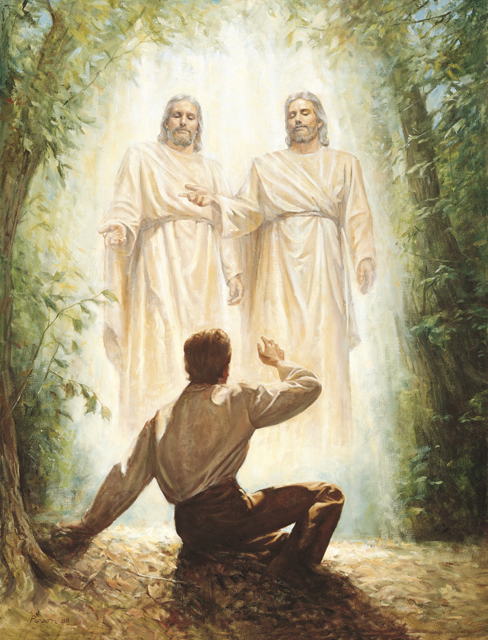
Heavenly Father and Jesus Christ as
They appeared to Joseph Smith in the
First Vision
I thought I would share some of my beliefs about God that are really special to me. I know that God is our Heavenly Father and that He loves us so much, more than we can imagine. I know that Jesus Christ is His Only Begotten Son and that it is through Christ's Atonement that we can live with Heavenly Father again. I know that the Holy Ghost works in perfect unity with Heavenly Father and Jesus Christ to teach me truth, comfort me when I am feeling down, and warn me of ways I need to improve myself.

Through sincere prayer and through reading the Bible and Book of Mormon, I have come to know that Heavenly Father, Jesus Christ, and the Holy Ghost are three separate Beings that are one in purpose. That purpose is to help us be saved and return to live with Heavenly Father as part of His family forever. These three Members of the Godhead work in such perfect unity that the scriptures sometimes describe them as "one God." I know that I can have a personal relationship with each of Them.

I know that God's purpose is to help us achieve "immortality and eternal life" (Moses 1:39). I am a child of Heavenly Father and thus I have the potential to become like Him. I know that He has placed us in families to learn and practice the gospel of Jesus Christ. I know these things are true, but more importantly, you can know for yourself that they are true. I promise in the name of the Lord that if you sincerely read the Book of Mormon, ponder its teachings and pray to know it is true, you will receive a spiritual answer from our Father in Heaven. You will know for sure.

Thursday, February 13, 2014

Addiction recovery

We visited someone who had overcome an alcohol addiction and recently been baptized but then fell into his old habits and stopped coming to church. The Atonement of Jesus Christ is so important because many of us fall even after we make sacred covenants and promise to live the commandments.

A stake president in my last area said that life is like a single tennis match. The outcome of this match decides your destiny forever. You have been playing for three or four years, but on the other side of the court is Satan, who has been playing for twenty trillion years (figuratively). You cry out to Heavenly Father for help because there is no way you will defeat Satan on your own. Heavenly Father promises you two things: first, he will send Jesus Christ to be your partner on the court (like a doubles game). Jesus Christ will catch all the hits you miss. Heavenly Father will also send the Holy Ghost, which can tell you where the tennis ball will go before it gets there. If you use this help, you cannot fail.

Two ways Heavenly Father helps us become free include:
  1. Avoiding addiction in the first place, or preventing it from happening again (the Holy Ghost).
  2. Recovering from addiction if you mess up (Jesus Christ's Atonement).
After we repent from sins, we often sin again and again. Heavenly Father understood and planned for this possibility! He gave us commandments knowing perfectly well that we would sometimes surrender to temptations, be weak, and rebel against His commandments. Just as Satan's temptation isn't turned off in this life, we also must not turn off our efforts to repent each and every day. While the Atonement doesn't give us license to sin, it can help us recover.

The Church of Jesus Christ of Latter-day Saints runs an Addiction Recovery Program for anyone who is struggling with any kind of addiction. It is based from the Twelve-Step Alcoholics Anonymous program but includes gospel principles from the scriptures and prophets and apostles in our day.

Friday, February 7, 2014

"Master, the Tempest is Raging!"

One of my favorite musical numbers in the October 2013 General Conference was the Mormon Tabernacle Choir's performance of what is maybe a lesser-sung hymn, "Master, the Tempest is Raging!" My experience with discouragement makes this hymn personal to me. The setting is from Matthew 8:23-27:
And when he was entered into a ship, his disciples followed him. And, behold, there arose a great tempest in the sea, insomuch that the ship was covered with the waves: but he was asleep. And his disciples came to him, and awoke him, saying, Lord, save us: we perish. And he saith unto them, Why are ye fearful, O ye of little faith? Then he arose, and rebuked the winds and the sea; and there was a great calm. But the men marvelled, saying, What manner of man is this, that even the winds and the sea obey him!
The beautiful chorus shows Jesus' assurance that with His help, we can be calm and overcome any tempests in our life.

The winds and the waves shall obey thy will:
Peace, be still.
Whether the wrath of the storm-tossed sea
Or demons or men or whatever it be,
No waters can swallow the ship where lies
The Master of ocean and earth and skies.
They all shall sweetly obey thy will:
Peace, be still; peace, be still.
They all shall sweetly obey thy will:
Peace, peace, be still.


I know that Jesus Christ is far more powerful than Satan will ever be. Through His Atonement, we will overcome all challenges if we follow His commandments, just as Joseph Smith and Jesus' Apostles did.

Faith precedes miracles

In the Book of Ether in the Book of Mormon, the prophet Moroni talks about how we must exercise faith in God before receiving His promised blessings. In Ether 12:6, we read:
And now, I, Moroni, would speak somewhat concerning these things; I would show unto the world that faith is things which are hoped for and not seen; wherefore, dispute not because ye see not, for ye receive no witness until after the trial of your faith. (Underline added.)
When we talk about Joseph Smith's First Vision, we focus a lot on the fact that Heavenly Father and His Son Jesus Christ both appeared to Joseph Smith and not as much on the intense tribulation that immediately preceded Their visit. Joseph Smith had decided on a time and place to ask God about what church was true, the Sacred Grove in Palmyra, New York being the place where "the place where [he] had previously designed to go" (JS-H 1:15). After beginning to offer his prayer, Joseph Smith was attacked by Satan, who did everything possible to prevent Joseph from asking God the question that would lead to us having Jesus Christ's true Church on the earth again (JS-H 1:15-16):
...I kneeled down and began to offer up the desires of my heart to God. I had scarcely done so, when immediately I was seized upon by some power which entirely overcame me, and had such an astonishing influence over me as to bind my tongue so that I could not speak. Thick darkness gathered around me, and it seemed to me for a time as if I were doomed to sudden destruction. But, exerting all my powers to call upon God...just at this moment of great alarm, I saw a pillar of light exactly over my head, above the brightness of the sun, which descended gradually until it fell upon me.
Only after enduring Satan's trial did Joseph Smith see Heavenly Father and Jesus Christ.

I too occasionally have experiences like this on my mission. I will feel terrible and discouraged in the morning, which leads to feelings like those of depression. Often I won't want to do any work at all but will still feel horrible sitting in our apartment. Many missionaries (probably most of them at some point) will experience serious trials of faith. But by exercising faith in Jesus Christ, praying for strength through His Atonement, and getting up to work anyway, we can and do overcome these discouragements sent from the devil. Once I start working, I always feel much better. First exercise faith, and then the blessings follow.

Tuesday, February 4, 2014

What proof is there for the Book of Mormon [Part 2]

How do we obtain proof?


In the October 2013 General Conference, Elder Jeffrey R. Holland described the pattern we must follow to obtain the Lord's help: "If you had appendicitis, God would expect you to seek a priesthood blessing and get the best medical care available. So too with emotional disorders. Our Father in Heaven expects us to use all of the marvelous gifts He has provided in this glorious dispensation."

For example, if I were to take an examination in school, He will not--indeed, He cannot--help me earn a high grade on the test if I pray for success without first putting forth my honest effort to study the material. He simply will not cheat for me. To learn academic truths, I must humble myself and not only pray but also sacrifice time and effort to read the course material, practice doing problems, and ponder the truths I have learned.

To learn spiritual truths, I must humble myself and sacrifice time to read the scriptures and the words of modern prophets, practice and apply the principles described in those words, and ponder what they mean. In other words, only once I am taking action can I expect Heavenly Father to answer a prayer about whether the things I am reading and learning are true. As President Spencer W. Kimball once said, "You must go to the spiritual laboratory, use the facilities available there, and comply with the governing rules. Then you may know of these truths just as surely, or more surely, than the scientist knows the metals, or the acids, or other elements" ("Absolute Truth", Ensign, Sept. 1978).

For example, how can we know that the Book of Mormon is true? Heavenly Father would expect us to read from the Book of Mormon and then pray to Him and ask Him in prayer what we have read is truth. The more specific our questions are, the more clear the answer will be.

What proof is there for the Book of Mormon? [Part 1]

We were talking with a man (I'll call him John) the other day who was uncomfortable with the Book of Mormon. John opened his Bible, which in the first few pages contained annotations and maps and historical notes about events in the Bible and effectively said to us, "When I open my Bible, immediately I have maps showing missionary tours of the Apostles , I have historical dates, I have archaeological evidence of Christ's life, and much more. When I open your Book of Mormon, none of that is there."

In other words, "Where is your proof that your Book of Mormon is true? Where is the evidence? Where are the dates and the history? Why should you expect me to blindly accept as true a book of scripture supposedly translated by one man? Why do I need to have blind faith in the Book of Mormon when my Bible is replete with evidence?"

The answer is that God doesn't require blind faith. He expects you to read from the Book of Mormon and then sincerely pray and ask Him if it is true and if the Prophet Joseph Smith was really a true Prophet. One of the answers given on Mormon.org puts it very clearly:
Over my lifetime, I have heard countless theories concerning Joseph Smith - his intellect, his integrity, his sanity, everything about him. Some of the stories about him being a prophet sounded convincing... but then, some of the stories of him as a criminal sounded convincing, too. Then I read about Joseph Smith's visitation by the angel Moroni. Moroni told him that his name would be "had for good and evil among all nations, kindreds, and tongues, or that it should be both good and evil spoken among all people." Well, that was certainly a true prophecy. So, it seemed, whether Joseph Smith was a prophet or not, tons of accusations and slander would be said against him anyway! That realization made me understand that only God could confirm whether or not Joseph was truly called of him. I got a strong confirmation of that truth. When others tell me that they "know the truth about the Joseph Smith," I always question their sources - it's usually a book or magazine article, possibly even by an esteemed, intellectual person. But I cannot and will not question my source of the real answer. -- Mike
As missionaries, our calling is not to prove to you the truthfulness of the Book of Mormon. Instead, we invite you to find out for yourself by going straight to the Source of all truth: God himself. Only through praying to our Heavenly Father and receiving an answer through the Holy Ghost can you know for sure, beyond any doubt, that the Book of Mormon is true and that Joseph Smith was a prophet of God.

Our imperfect human bodies

I often have a lot of trouble sleeping at night and my missionary companion has trouble waking up in the morning. Nevertheless, the Lord has called us to be missionaries for His Church in this area and though we have had some slow weeks, we are blessed with teaching appointments and the ability to share the gospel. We are teaching a man who has muscular dystrophy and has grown up in a very rough life. Nevertheless, the Lord has helped him overcome his weakness and blessed him with good business skills and a desire to recover from his past mistakes.

I think of Elder Russel M. Nelson's remarks in the October 2013 General Conference about our weaknesses:
...It seems that in every family, if not in every person, some physical conditions exist that require special care. A pattern for coping with such a challenge has been given by the Lord. He said, “I give unto men weakness that they may be humble; … for if they humble themselves … and have faith in me, then will I make weak things become strong unto them” [Ether 12:27]. Stellar spirits are often housed in imperfect bodies.
All of us have different weaknesses. For example, I have a lot of trouble concentrating on the scriptures and missionary lessons during studies in the morning. I also have a tendency to let conflict build in my mind without discussing it with my companion, which makes it difficult to concentrate and be happy. But as I think about Christ and the love He had for all people, it makes me able to put myself aside and begin to love them in the way He would.

I think of the examples of people who have disabilities much more challenging than mine. A woman who lost both of her legs continues to work and even swim:


Also, a man who has muscular dystrophy has nevertheless grown up into a successful businessman and father:

Wednesday, January 22, 2014

The Gift of the Holy Ghost

Sometimes people ask us why baptized into The Church of Jesus Christ of Latter-day Saints is different from other churches. We believe in being baptized by immersion, just the way Jesus Christ was baptized, by proper priesthood authority. Something else we believe is that baptism by immersion is only half of the equation -- we must also receive the Gift of the Holy Ghost. One without the other is sort of useless. After we are baptized, we receive the Holy Ghost during a normal Sunday meeting. Someone who holds God's priesthood authority will lay their hands on our head and confirm us a member of The Church of Jesus Christ of Latter-day Saints and give us the Gift of the Holy Ghost.

What is the Gift of the Holy Ghost and why is it so important? The Holy Ghost is one member of the Godhead (which also includes Heavenly Father and Jesus Christ; these three are separate beings but are one in purpose). Basically, all people can receive guidance from God our Heavenly Father through the Holy Ghost to help them in their lives and help them come closer to Him. Many people throughout all of history have prayed and received answers to their prayers this way.

But after we receive the Gift of the Holy Ghost, we can have not only fleeting or occasional guidance from God but the right to the constant companionship of the Holy Ghost. If we try and follow Jesus Christ and pray and follow His commandments, we are not only allowed but entitled to have the Holy Ghost's influence in our lives.

Let me give an example. One time in school, I was doing an assignment for a math class. Part of the assignment was to write short computer programs that would show we understood the math, and even though I mostly understood the math, I would often make small errors on the computer and lose points for it. One week we had an assignment due a day earlier than I thought it was, so I was scrambling to get it done in time.

In the grand scheme of things, it probably wouldn't have made much difference to Heavenly Father whether I got an A on the assignment or not. But I really wanted to reach the right answers and make up for some bad grades earlier. I prayed multiple times at the computer and asked for the guidance of the Holy Ghost to help me understand the problem and how to put it into the computer. Gradually, I was able to see what the professor wanted us to do and write the computer code the right way. At one point, I felt like I should look at a certain line of code and found an error I had made. Things worked as I had prayed. I ended up finishing that assignment much more quickly than previous assignments and I got a great grade on it.

Which tells me that Heavenly Father loves me. Although that assignment probably won't make the slightest difference in the big picture, He wants me to know that He loves me, and He can do that by sending guidance and revelation through the Holy Ghost.

As I've come to feel and understand the Holy Ghost, my view of life has changed and I'm able to see beauty in so many parts of my life, even those times that seem unbearable. I appreciate the sanctity of live and I'm  more grateful for my experiences. This gift is not something Latter-day Saints try to lord over people. We want all people to be able to have this in their lives. Jesus Christ's gospel and His Church give us so much happiness and we just want to share that with others.

Tuesday, January 14, 2014

A bad experience with pride

A few days ago we had to drive to the mission office to take care of some business. I was the assigned driver of the car, which means I am supposed to drive the car and my companion is supposed to give an extra set of eyes to watch for dangers on the road. Usually I am the only one to drive unless I am injured or impaired, in which case he would drive.

From the few times my companion had driven the car, I had quietly decided in my mind that he was an inferior driver. I didn't like the way he accelerated or turned or braked (notwithstanding the fact that he had been on bike his whole mission and didn't have the ample opportunity I did to practice driving). During our visit to the mission office, I was afraid he would ask me if he could drive the car and started thinking about his flaws and how he might get us into an accident.

I was fatigued that day because of lack of sleep while my companion was not. While driving on the way home, I myself zoned out for a minute and ran a red light with a camera. After spending about ten minutes stressed out after I additionally missed the freeway entrance, I finally pulled into a parking lot and acknowledged that in my state of mind there was no way I would be safer on the road than he would be and let him drive home. Had I not acknowledged my pride, I may have harmed my companion and other people as well.

To be prideful is to place more trust in ourselves than in the Lord or to put the things of the world above the things of God. Pride is competitive; those who have it presume they are better than others. It is strongly condemned in the scriptures and impedes our spiritual progress. (See Preach My Gospel [2004], p. 120 or the online version.) Proverbs 16:18 is a wonderful summary of this: "Pride goeth before destruction, and an haughty spirit before a fall."

Thursday, January 2, 2014

Weaknesses and shortcomings are part of life

One of my favorite scriptures in the Book of Mormon is Ether 12:27:
"And if men come unto me I will show unto them their aweakness. I bgive unto men weakness that they may be humble; and my cgrace is sufficient for all men that dhumble themselves before me; for if they humble themselves before me, and have faith in me, then will I make eweak things become strong unto them."
In this scripture, Jesus Christ is speaking to the prophet Moroni. He is saying that all people will have some weakness or deficiency in this life. This is necessary because we must all humble ourselves before Him in order to return to His presence. The Lord also shows us how we can overcome our weaknesses: we must have faith in Him. Having faith in Jesus Christ means we must trust Him enough to follow His commandments even when we don't completely understand the reason for following them. It also means that we believe that He loves us.

Some people have difficulty in school. Some people struggle with significant physical limitations. Some people have addictions to drugs or pornography. Some people have trouble feeling that they are loved or worthwhile. But all of these weaknesses can be overcome through Jesus Christ's Atonement if we will humble ourselves and have faith in Him.

Welcome

I am Elder Sam Young. I'm a missionary for The Church of Jesus Christ of Latter-day Saints serving in Orange County, California. We share the message that Jesus Christ lives and that the church He formed in His lifetime has been restored to the earth today by a loving God through the Prophet Joseph Smith. Through His restored church, we can come closer to God, find happiness in our lives and families, and come to personally know Jesus Christ. The Book of Mormon: Another Testament of Jesus Christ is convincing evidence that Jesus Christ's gospel has been restored. I know for myself that this message is true and we invite you to hear this message and come to know for yourself that it is true. One way to do this is by reading The Book of Mormon and asking God in prayer to know if it is true. I have done this and have received an answer that it is true.

My mission is using the Internet to share the gospel of Jesus Christ and help others to come unto Christ. This website is a place where I will share special experiences I have as a missionary and spiritual messages that can uplift others. Please feel free to comment on my posts, but don't post inappropriate or defamatory comments.

Everything that I write or say here is my own view and my posts are not authorized or official statements by the Church.